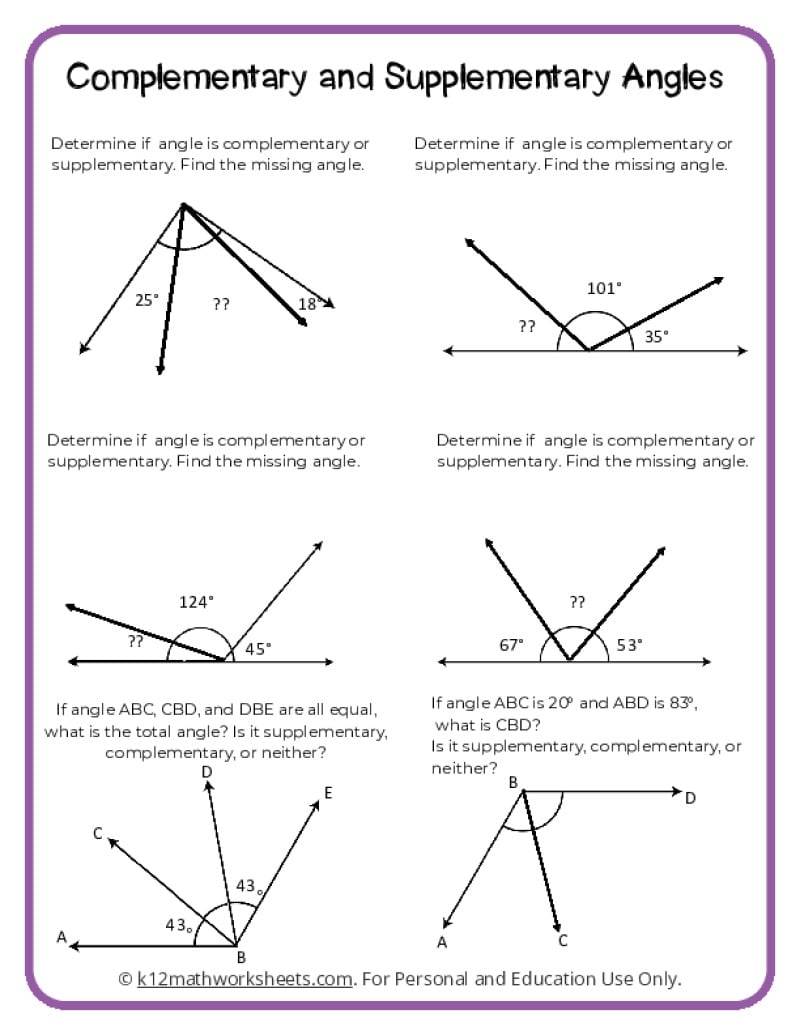
Understanding complementary and supplementary angles is essential in geometry. Complementary angles add up to 90 degrees, while supplementary angles add up to 180 degrees. To reinforce this concept, worksheets are a great way for students to practice and solidify their knowledge.
Complementary and supplementary angles worksheets typically include a variety of problems for students to solve. These problems may involve identifying angles that are complementary or supplementary, finding missing angles, or determining the relationship between given angles. By working through these worksheets, students can strengthen their understanding of angle relationships and improve their problem-solving skills.
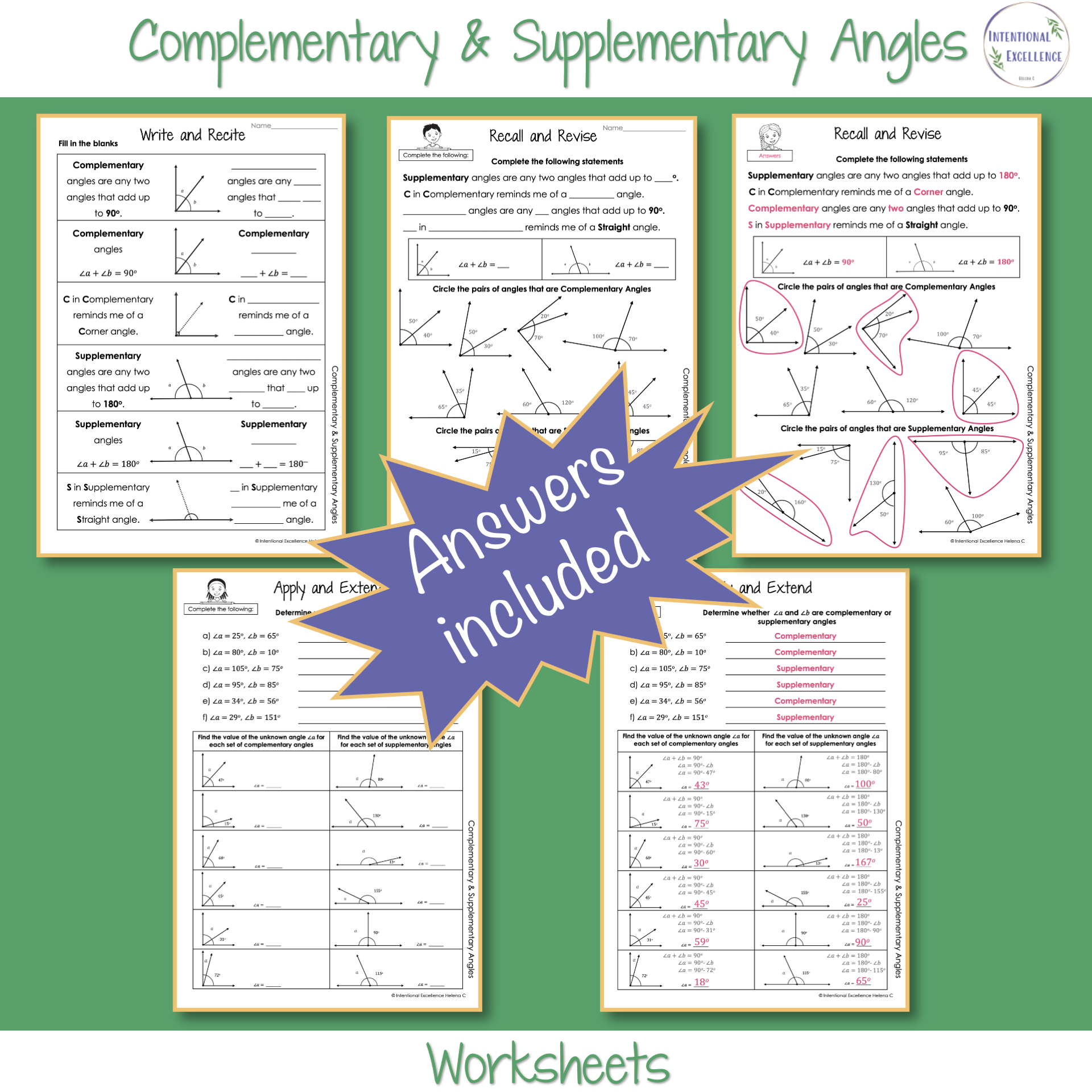 Complementary And Supplementary Angles Worksheet
One type of problem commonly found on complementary and supplementary angles worksheets is identifying pairs of angles that fit the specific criteria. For example, students may be asked to find two angles that are complementary to each other or to identify a pair of supplementary angles. By practicing these types of problems, students can become more familiar with recognizing angle relationships and applying the properties of complementary and supplementary angles.
Another common problem on these worksheets is finding missing angles in a given figure. Students may need to use their knowledge of angle relationships to determine the measure of a missing angle based on the information provided. This type of problem helps students develop their problem-solving skills and apply their understanding of complementary and supplementary angles in real-world scenarios.
Additional problems on complementary and supplementary angles worksheets may involve solving equations to find the measures of unknown angles. By incorporating algebraic concepts into angle problems, students can further enhance their critical thinking skills and mathematical abilities. These types of problems challenge students to think creatively and apply their knowledge of angles in a more complex setting.
In conclusion, complementary and supplementary angles worksheets are valuable tools for students to practice and reinforce their understanding of angle relationships. By working through a variety of problems, students can improve their problem-solving skills, enhance their critical thinking abilities, and deepen their knowledge of geometry. These worksheets provide a hands-on approach to learning about complementary and supplementary angles, making geometry more engaging and accessible for students.